
Canoe Poling Teaching Resources
A collection of various teaching resources directly related to teaching canoe poling.
Introduction to Canoe Poling
The use of a pole to propel and control a watercraft has existed in most parts of the world where water depth and bottom conditions allow its use. The simplicity of the skill suggests it may pre-date the use of paddles or oars.
In eastern North America, poling is a skill that was developed by native cultures along with the evolution of their watercraft. It was, and is, a skill which allows for one or two people to move relatively heavy loads up and down stream in shallow conditions with minimum effort and maximum control. The topography of the area, with numerous shallow lakes and shallow, rocky, mild to medium gradient rivers made the value of the skill obvious to European immigrants. They learned and used aboriginal skills to travel, hunt and transport goods and people.
With the introduction of lumbering, particularly for log drives (necessity to transport, cooking boats, equipment, etc), poling became a valued working skill. Those skill sets have since transferred to the sport fishing and hunting industry. By the early twentieth (20th) century, technological advances in the lumbering industry had reduced and eventually eliminated the value of poling as a job-related skill. However, poling survived in sport fishing and hunting and remained an essential job skill in that sector well into the 1960’s in many areas. The gradual introduction of outboard motors changed boat designs and reduced but did not eliminate the use of poling as an employment skill. Poling is still a desired skill among river guides.
Styles of Poling
Three relative distinct styles of poling have developed in the modern era:
- Traditional
- Sport
- Recreational
Traditional style poling is what is still employed by many professional guides in the North-eastern United States and Eastern Canada. This often involves the use of wood canvas canoes and single ended black spruce or ash poles, which are ‘shod’ with a traditional forged tip of iron or brass, covering the thick end of the pole. This ‘setting pole’ is used to move guests and equipment upstream, by moving the canoe and load from eddy to eddy by pushing on the riverbed. To return downstream, the pole is employed to ‘snub’ on the riverbed to slow or stop the canoe to provide a slow, safe descent of the river.
Sport poling involves the use of light modern canoes of synthetic composition and a double-ended aircraft aluminium pole. Participants race against the clock or each other to ascend and descend a stretch of rapids while passing forwards or backwards through marked gates. Because it is a race, the emphasis is on speed and efficient boat movement. Competitors like Harry Rock and Chip Cochrane from the State of Maine have pushed sport poling to a world-class level.
Recreational poling is a blend of both the traditional and racing style and borrows heavily from both. Modern and synthetic boats are often used as well as double ended ‘shod’ poles of either black spruce or aluminium. The advantages of poling for recreational canoeists are many, including:
- improved vision because of the standing position, and
- an extended season as water levels drop due to the fact that the canoe can be propelled and precisely controlled, either up or down stream as long as enough water allows floating a canoe and load.
The direct application of force on the river bottom allows the poler to ascend and descend currents, which would be beyond the ability of paddlers, in similar conditions. In general, canoe poling has developed where waterways generally have reasonably firm bottoms (gravel, ledge and boulder bottoms, etc.). Reasonably firm waterway bottoms allow a proper pole plant and consequently, precise control of a canoe.
Obviously, there are waterways where waterway bottoms are soft such as marsh areas, swamp areas, wetlands, or shallow non-moving water systems. Soft bottom waterways can be traversed via use of a marsh foot. A marsh foot grabs when pushing through mud and muck, giving the poler purchase. There are several commercial products, or some folks may develop their own.
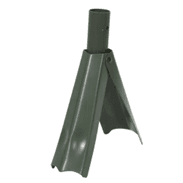
This document deals with canoe poling where waterway bottoms are generally firm.
Adler filled waterways may be negotiated via use of a shorter pole than the traditional 12’ pole normally utilized in rivers. A shorter pole allows for easier manipulation of the pole, avoiding or reducing entanglement with alders.
Teaching Tips
Generally speaking, recommend teaching with another certified instructor regardless of meeting the instructor/student ratio.
- Use of a “model river” utilizing throw bag, mini canoe, teaching aids, etc
- For a combined Intro Solo Poling and an Intermediate Solo Poling Course, or an
- Advanced Canoe Poling course, a theory session works well as an evening session immediately prior to the days on the water.
- Teachable moments dependent on questions posed by students or instructor observations, etc. Make all students aware of peer individual questions.
- Adult learning theory
- Games
Stunt Learning Tips
Instructors can introduce fun activities to assist with learning. For example the following:
- rock the canoe side to side (Knees bent shifting pressure from side to side, legs absorb pressure, maintain balance)
- dipping your toes (balancing skill): tilt canoe with one foot in canoe & other foot in water to opposite side of canoe
- pole from the seat
- thwart hop
- rotational hop: 180 degrees one-handed poling
Canoe Poling Resource Materials
Books
Beyond the Paddle by Garnett Conover
Published in 1991
Old Bridge Press
Canoe Poling by Harry Rock
“Standing Tall and Carrying a Big Stick”
Published in 2006
Little Dancer Ltd.
Canoe Poling by Al, Syl and Frank Beletz
(Somewhat dated for an added read if available)
Published in 1974
C. MacKenzie Press, St. Louis, Missouri
DVD’s
Canoe Poling by Harry Rock
“Standing Tall and Carrying a Big Stick”
Last updated: April 11, 2026
Published: February 24, 2025