
Instructional Frameworks for Adult Outdoor Education
Learn about various resources and frameworks related to instruction in the outdoors.
Instructional Frameworks
Paddle Ready Position > Stance, Symmetry, Pivot, Edge, Timing, Co-ordination
Most kayak strokes can be broken down into the six key principles which all come into play to make a stroke effective. After the candidate starts in a paddle ready position they will make use of stance, symmetry, torso pivot, edging, timing and coordination to complete the stroke.
Both instructors and participants need to be coached to always go back to these first principles as this reminds them to ground every moment in these basic concepts.
Examples of the principles could include:
Stance – Body upright and shoulders back, head up and looking to where you want to go, arms out and ready to apply power.
Symmetry – The path of the paddle through the water on both sides or the amount of power applied should be the same on both sides of the kayak.
Pivot – Allowing you to reach forward farther or to help pull the paddle through the water using less arm muscles.
Edge – Put the kayak on an edge to assist with turning allowing for a tighter turn or more responsive kayak.
Timing – Understanding the body mechanics to do a kayak roll is important but timing is also a major factor in ensuring it will be successful.
Coordination – Together with timing, many of the strokes (especially combination strokes) require maneuvers to be done in a specific order which requires the coordination of body mechanics, weight shift, etc.
Levels of Edging
The benefits of edging a kayak are enough that beginners should be introduced to the concept right from the start.
As participants gain more confidence and move up the certification levels, they should be encouraged and eventually expected to put their kayak on a greater and greater edge for better performance.
To help with the standardization of how much of an edge a participant should apply at any given level, we have developed a rough framework along with a short description:
#1 Edge: slight pressure and weight shift on sitz bone/knee. The kayak on a slight angle.
#2 Edge: medium pressure. Depending on the kayak design, the deck/hull seam could be in the water.
#3 Edge: near capsize pressure. The participant should be prepared to brace to stay upright if necessary. The outer edge of the kayak skirt could be nearly touching or just under the water.
Please note that these are only rough guidelines as many factors can affect the amount of edge applied including hull design, kayak beam, water conditions, empty or loaded boat, participants’ confidence, body weight and/or their fit in the kayak.
Paddling Progression with Speed
Angle/Motion/Tilt
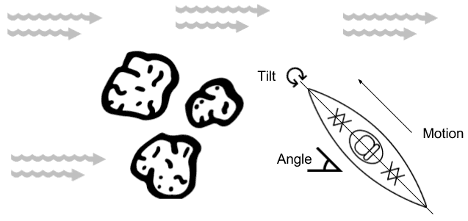
A good framework for thinking about strokes while the kayak is under motion or current is to think about angle, motion, and tilt. Angle refers to the kayaks angle in relation to the current, wind or other outside factors. Motion refers to the kayaks’ or current speed. Tilt refers to both the amount of edging necessary to complete the maneuver but also which side you need to apply the edge.
As a participant moves up through the certification levels and the speed of the kayak or current speed increases, the consequences for error likewise increases and thus, it becomes necessary to pay closer attention to these aspects.
The example below of a kayak peeling out into current is a good application of the key elements of angle, motion and tilt.
Situational Awareness Frameworks
Me, We and the Sea
Me, We and the Sea is a good framework for thinking about a paddler’s situational awareness skills within a group as they move from beginner to advanced.
Beginner paddlers don’t have the capacity or experience to think about others as they are naturally focused on their own paddling needs. As they gain skills and judgment, intermediate paddlers start to develop the capacity to think about themselves in the context of a member of a group and such, they can take on small tasks and basic leadership activities.
Advanced paddlers have the skills, comfort level and most importantly, experience to be able to quickly analyze a situation including both the group and local environment (the sea) and be able to make effective decisions accordingly.
The Me, We and the Sea framework also ties into peer leadership as the leader of the group needs to be aware and adjust the decision making based on the experience and skills of the group.
Leaders need to be aware that paddlers under stress can narrow their situational awareness. For instance, an intermediate paddler who would normally think about the group may be solely focused on themselves in a crisis.
Last updated: April 11, 2026
Published: January 2, 2025